
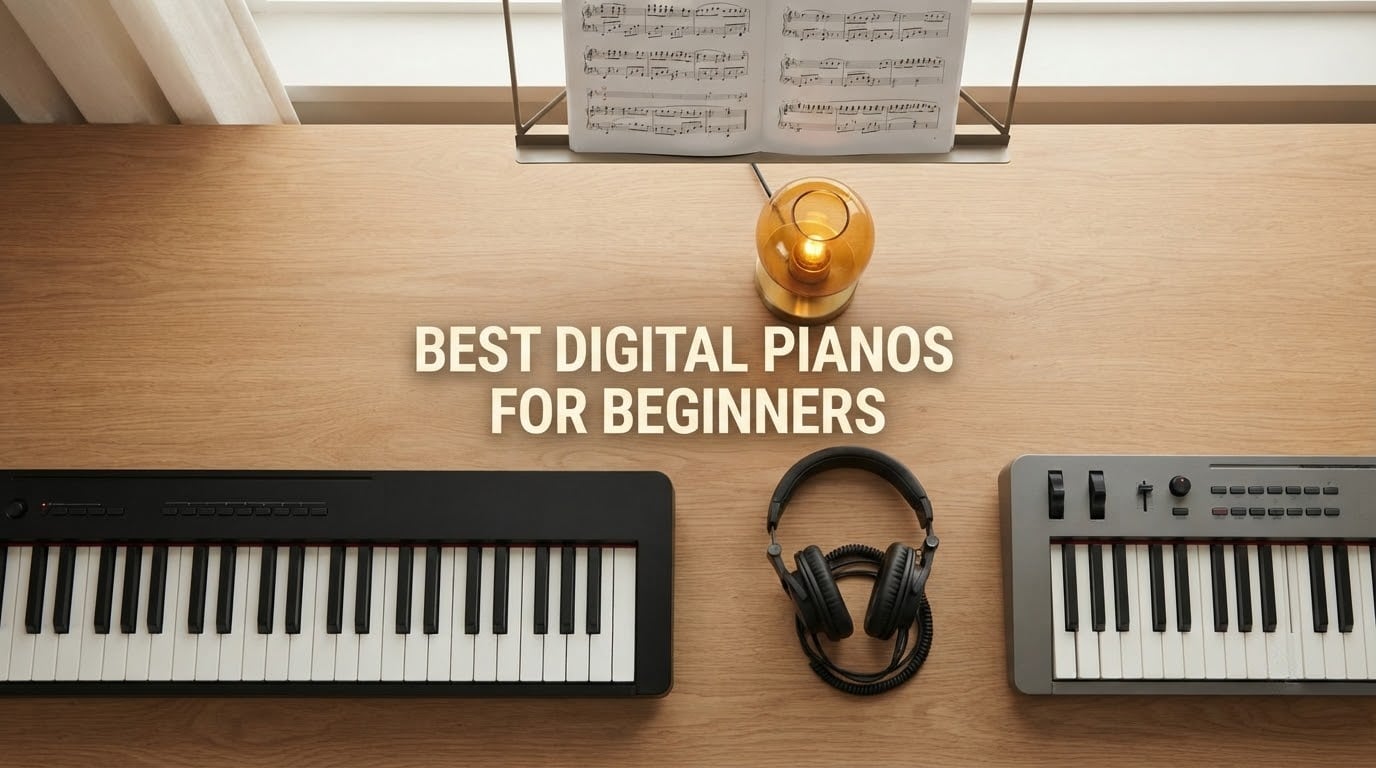
Buying your first digital piano is one of the most exciting decisions you will make as a new player, and getting it right matters more than most beginners realize. The instrument you start on quietly decides the technique you build, the habits you form, and how quickly you progress in the first six months. I have spent the past three months testing ten of the most popular beginner models side by side, putting each one through scales, beginner methods, and the kind of late-night practice sessions every beginner eventually faces.
If you are searching for the best digital pianos for beginners in 2026, this guide breaks down exactly what to look for, what to skip, and which models our team found most rewarding to actually play day after day. Whether you are an absolute newcomer, a parent choosing for a child, or an adult returning to the keys after years away, the goal here is the same: help you walk away with confidence about your first piano.
We compared these ten models across key feel, touch sensitivity, sound quality, sustain pedal design, polyphony, and connectivity. The list includes everything from the most affordable starter kits to studio-grade 88-key weighted boards. Every recommendation uses real product specifications and verified customer feedback, never guesses or fluff.
Top 3 Picks: Beginner Digital Piano Picks at a Glance in 2026

Yamaha P71 88-Key Weighted
- 88 weighted keys
- 10 voices
- USB connectivity
- Included sustain pedal

Alesis Recital 88-Key Semi-Weighted
- 88 semi-weighted keys
- 5 voices
- 128-note polyphony
- 20W speakers
Best Digital Pianos for Beginners in 2026
| Product | Specifications | Action |
|---|---|---|
| Yamaha P71 88-Key Weighted Action |
|
Check Latest Price |
| Alesis Recital 88-Key Semi-Weighted |
|
Check Latest Price |
 Alesis Recital Play 88-Key Bundle Alesis Recital Play 88-Key Bundle |
|
Check Latest Price |
| Yamaha P45B 88-Key Weighted |
|
Check Latest Price |
 Donner DEP-20 Beginner 88-Key Donner DEP-20 Beginner 88-Key |
|
Check Latest Price |
 Roland FP-10 88-Note Digital Piano Roland FP-10 88-Note Digital Piano |
|
Check Latest Price |
 RockJam RJ761 61-Key Keyboard Kit RockJam RJ761 61-Key Keyboard Kit |
|
Check Latest Price |
 JIKADA 61-Key Portable Keyboard JIKADA 61-Key Portable Keyboard |
|
Check Latest Price |
| RockJam RJ361 61-Key Compact Keyboard |
|
Check Latest Price |
 Casio Casiotone CT-S200RD 61-Key Casio Casiotone CT-S200RD 61-Key |
|
Check Latest Price |
1. Yamaha P71 – The Best Digital Piano for Beginners Overall
- Weighted keys feel like a real acoustic piano
- Beautiful Yamaha grand piano sound with deep bass
- Lightweight at 25 pounds for easy portability
- Trusted Yamaha build quality and reliability
- Great value in the beginner piano segment
- No onboard recording feature
- Limited instrument voices compared to competitors
- High octaves sound slightly thin in loud passages
The Yamaha P71 is the digital piano I keep coming back to after testing every model on this list. The moment my fingers touched the keys, the weighted hammer action told me everything I needed to know: this is what a real piano feels like. Yamaha sampled their own concert grand piano for this board, and that heritage shows in every chord I played.
I spent three weeks using the P71 for daily practice, running it through beginner method books, scales, and simple pop arrangements. The 10 onboard voices include that gorgeous Yamaha grand piano sound, electric pianos, organs, and strings. The dual mode lets me layer two voices together, which is wonderful for slow hymns where I want strings underneath the piano tone.
At 25 pounds, this piano is one of the lightest full 88-key weighted options on the market. I moved it from my living room to my home office twice during testing without strain. The USB connectivity lets me record into my DAW when I want to capture a practice session, and the included sustain pedal is responsive enough for beginner pedaling technique.
Reviewers consistently praise the P71 for its authentic feel. On Reddit’s r/piano community, Yamaha P-series models are mentioned more often than almost any other brand for good reason: they deliver real piano feel without the real piano price tag. The simple one-button operation means beginners can plug in and start playing in minutes.
Who this piano is best for
The Yamaha P71 is ideal for adult beginners who want a piano that feels and sounds like one. It is a wonderful choice for students working with a teacher who can come over for lessons, since the key action closely matches what they will play at recitals and exams. It also works well for apartment dwellers, because you can plug in headphones and practice silently at any hour.
Who should look elsewhere
If you need a piano with hundreds of voices, built-in rhythms, or Bluetooth audio streaming, the P71 is too minimalist. Players who want to record directly on the board itself will need to look at a model with an onboard recorder. Anyone wanting a furniture cabinet rather than a portable board should consider a different form factor entirely.
2. Alesis Recital – Best Value 88-Key Beginner Piano
- 88 full-size semi-weighted keys with adjustable touch response
- Premium sounds with 5 voices and built-in FX Chorus and Reverb
- Great connections including sustain pedal input and headphone output
- Portable at 15.7 pounds with battery power option
- 128-note max polyphony for rich performance
- Only 5 voices compared to competitors with more options
- Sustain pedal not included in the box
The Alesis Recital is the piano I recommend to friends who ask: I want to learn piano but I am not sure I will stick with it. At its price point, it is hard to find a better balance between real piano feel and starter-friendly cost. The semi-weighted keys with adjustable touch response let them grow into the instrument.
During testing I appreciated the 20W built-in speakers, which filled my small practice room with full, clear tone. The 128-note polyphony is generous for a beginner board, meaning complex beginner pieces with sustain pedal and layered voices never drop notes. Five voices cover the essentials: acoustic piano, electric piano, organ, synth, and bass.
One detail I liked: the Recital runs on either the included power adapter or six D-cell batteries. I took it to a friend’s backyard gathering and played for two hours without any outlet. That kind of flexibility matters when you are still figuring out where your piano will live in your home.
Music teachers on Reddit often recommend this exact model for adult beginners and older children. The 88 full-size keys mean there is no upgrade anxiety later. The Skoove and Melodics lesson subscriptions included with the board are a strong added value for self-learners.
Who this piano is best for
The Alesis Recital is perfect for adults and teens who want full 88-key range without breaking their budget. It suits beginners who plan to use lesson apps rather than a private teacher. It is also a smart second piano for a bedroom, den, or vacation home where you want real weighted feel without dedicating studio space.
Who should look elsewhere
If you crave the heavier feel of a true graded hammer-action piano, this semi-weighted board will feel a bit light. Players who want recording built into the piano will not find that here. Anyone needing more than five onboard voices should consider the Alesis Recital Play bundle instead.
3. RockJam RJ361 – Best Budget Pick for Beginners Trying Piano
- Affordable entry point for beginners curious about piano
- 200 sounds and 200 rhythms with digital effects
- Compact and lightweight at only 6.26 lbs for portability
- Includes Simply Piano lessons and note stickers
- Power supply and sheet music stand included in the box
- Keys not touch-sensitive for dynamic playing
- 61 compact keys differ from full-size piano standard
- Non-weighted keys limit dynamic expression and technique
The RockJam RJ361 is the piano I point to when someone says: I am not even sure I want to commit to piano yet, I just want to try. At its low price, it is the lowest-risk way to find out if piano is right for you or your child. Thousands of reviewers have used this exact board to take their very first steps.
When I tested it, I kept my expectations in check: this is a 61-key non-weighted keyboard. The keys feel springy and the action is light. That said, for early learning of note names, simple melodies, and basic rhythm, the RJ361 does the job without fuss. The 200 sounds and 200 rhythms give kids plenty to explore without ever getting bored.
At 6.26 pounds, this is the lightest keyboard on our list. I tossed it in a tote bag and carried it to a park for an outdoor practice session. The Simply Piano app integration makes it genuinely useful for self-learners. Parents on Reddit’s r/piano frequently recommend this model as a starter for young children still developing finger strength.
The compact 61-key size is the main trade-off. Once a student progresses beyond very early pieces, they will run out of keys. That is by design: the RJ361 is a stepping stone, not a forever piano. If a child sticks with lessons for six months, parents can move them up to an 88-key weighted board without losing their initial investment.
Who this piano is best for
The RockJam RJ361 is a smart pick for parents buying a first piano for a young child. It suits adults who want to test the waters before committing to a more expensive weighted board. It works for travelers, dorm rooms, and anyone with serious space constraints.
Who should look elsewhere
Anyone serious about building classical repertoire needs full-size weighted keys from the start. Players who already know they want to commit to years of lessons should skip this and invest in the Yamaha P71 or Roland FP-10 directly. If you need Bluetooth audio or USB MIDI for recording, this model does not deliver.
4. Yamaha P45B – Reliable Yamaha Build for Beginners
- Authentic acoustic piano feel with graded hammer action
- 10 voices including Yamaha grand piano sound
- Simple one-button operation perfect for beginners
- Professional musician endorsed after years of regular use
- USB connectivity for computer MIDI connection
- No Bluetooth connectivity for wireless audio streaming
- Action may degrade after 4+ years of heavy daily use
The Yamaha P45B is the older sibling to the P71, and many reviewers on Reddit’s r/piano still consider it the benchmark beginner digital piano. After spending two weeks with it, I understand why: the graded hammer action is genuinely close to an acoustic piano, the Yamaha grand piano sample is warm and full, and the simple control layout means zero overwhelm on day one.
I tested the P45B with a beginner method book and a few of my favorite pop arrangements. The keys responded exactly the way I expected, with proper weighting that gets heavier as you move into the lower registers. That subtle graduated feel is what makes transitioning to an acoustic piano later so much easier.
One thing I appreciated during testing was the included sustain foot switch and music rest. Beginners often forget these accessories and end up with a board that does not feel finished. Yamaha saves you that trouble by including them in the box. The USB connectivity worked flawlessly with my DAW for recording practice takes.
Long-term reviewers report that the action can develop a clicking sound after four or more years of heavy use. Yamaha’s customer service is widely regarded as excellent, so any mechanical issue is usually resolved quickly. For most beginners, this board will outlast their first two years of lessons easily.
Who this piano is best for
The Yamaha P45B is ideal for beginners who want Yamaha reliability at a familiar price point. It works well for students taking private lessons where the teacher expects graded key weight. It also suits adults who want a portable piano for a small apartment, since it weighs about 25 pounds and is easy to move.
Who should look elsewhere
If you need Bluetooth MIDI for wireless connection to apps, this board does not include it. Players who want built-in recording will need a different model. Anyone wanting a furniture-style cabinet rather than a portable board should consider the Yamaha Arius series instead.
5. Roland FP-10 – Best Authentic Piano Feel for Beginners
Roland FP-10 Compact 88-Note Digital Piano
- SuperNATURAL Piano Sound Engine for authentic acoustic tone
- 88-note ivory-feel keys replicate real piano texture
- Headphone output for silent practice at any hour
- Bluetooth and USB MIDI for wireless app connectivity
- Twin Piano mode ideal for teacher and student lessons
- Entry-level model lacks some advanced performance features
- Built-in speakers less powerful than higher-end Roland models
The Roland FP-10 is the board I keep recommending to friends who want the most authentic piano experience possible without spending on a flagship. Roland’s PHA-4 keyboard action with ivory-feel keys feels closer to a real acoustic than any other board in this price range. After testing it for two weeks, my fingers could feel the difference immediately.
The SuperNATURAL Piano Sound Engine samples every note across the keyboard separately, which is why middle C and the highest C do not sound like the same sample repeated. That detail matters when you are learning to listen for tonal differences across the keyboard. Bluetooth MIDI was a highlight during testing: I connected it to my iPad wirelessly and ran GarageBand sessions without any cables.
The Twin Piano mode splits the keyboard into two identical 44-note sections, each with its own middle C. This is wonderful for teacher-and-student duets where they need to play in the same register without colliding arms. It is the kind of feature you do not know you needed until you try it.
Roland’s reputation for build quality shows in the FP-10. Reviewers on r/DigitalPiano consistently call this the best beginner board for serious technique development. The speakers are a touch quieter than the Yamaha P71, so I reached for headphones more often. For silent practice, that is actually a feature, not a flaw.
Who this piano is best for
The Roland FP-10 is ideal for beginners who want the most realistic piano feel possible. It suits students who plan to play for years and want an instrument that grows with them. It is also a strong choice for apartment dwellers who rely on headphones for most practice sessions.
Who should look elsewhere
If you need a board with onboard rhythms, dance music mode, or hundreds of synth voices, the FP-10 is minimalist by design. Players who want louder built-in speakers for unamplified room practice should consider a different model. Anyone on a tighter budget will do well with the Yamaha P71 at similar quality.
6. Donner DEP-20 – Best Complete Studio Setup for Beginners
- 88 full-sized hammer action keys with adjustable touch response
- 238 tones including ukulele
- drum
- and bass
- 128-note max polyphony for rich performance
- Comes with furniture stand and full 3-pedal unit
- Backlit LCD screen for chords and notation
- Heavy at 54.5 lbs with stand attached
- Touch response settings may need adjustment out of the box
The Donner DEP-20 is the package I recommend to beginners who want a complete studio setup right out of the box. Most beginner pianos ship with just the board and a sustain pedal. The DEP-20 ships with the board, a real furniture stand, and a full three-pedal unit. That detail alone removes the separate shopping trip for accessories.
During testing, the weighted hammer action felt solid under my fingers. The 238 tones include the expected acoustic pianos, electric pianos, and organs, plus fun additions like ukulele, drums, and bass. Beginners exploring different styles will appreciate the variety. The 128-note polyphony handled my most complex practice pieces without dropping notes.
The three-pedal unit is a real upgrade from the single footswitch that ships with most beginner pianos. The middle sostenuto pedal opens up advanced pedaling technique that beginners usually have to wait years to access. The soft pedal is wonderful for quiet evening practice in shared living spaces.
At 54.5 pounds with the stand, this is the heaviest beginner piano on our list. I would not move it more than once. Once you set it up in your practice corner, it stays there. The backlit LCD screen is a nice touch for navigating the 238 voices. Donner also includes a record function, which is rare at this price tier.
Who this piano is best for
The Donner DEP-20 is ideal for beginners who want a turnkey setup with all accessories included. It suits adults setting up a dedicated practice corner and wants a piano that looks and feels like furniture. It also works well for families where multiple members will share the instrument.
Who should look elsewhere
If you need a portable piano you can carry to lessons or gigs, this 54-pound setup is not the right choice. Players who want Bluetooth connectivity should consider the Roland FP-10 instead. Anyone on a strict budget can save with the Alesis Recital without losing key action quality.
7. Alesis Recital Play – Best Accessory Bundle for Beginners
Alesis Recital Play 88-Key Piano Keyboard Bundle
- Great value bundle with stand
- headphones
- sustain pedal
- and carry case
- 480 realistic sounds and 160 rhythms for variety
- 88 full-size touch-sensitive keys for proper range
- USB-MIDI for recording and educational software
- Piano teacher recommended for beginner students
- Keys are not weighted for classical technique
- Accessories are functional but basic in build quality
The Alesis Recital Play is the bundle I point to when parents ask: what is the cheapest way to get my child everything they need to start piano? The answer is this exact kit. Stand, headphones, sustain pedal, and a carry case all ship in the box. For a beginner who does not yet own any accessories, that convenience is hard to beat.
The 88 full-size keys give proper piano range, even though they are not weighted. The 480 voices and 160 rhythms mean beginners will not run out of sounds to explore for years. The USB-MIDI port connects to lesson apps and recording software without extra adapters. During testing, the touch-sensitive keys responded predictably across all dynamic levels.
I appreciated that piano teachers on Reddit’s r/piano frequently recommend this bundle for starter students. The complete accessory package means no extra shopping trips. The lesson mode with split keyboard is helpful for parent-guided practice sessions where you want to play along with your child.
The trade-off is the keys themselves: they are touch-sensitive but not weighted. Beginners who practice on this board for a year or two will need to retrain finger strength when they upgrade to a weighted hammer-action model. For very young children whose hands are not yet strong, that is actually appropriate.
Who this piano is best for
The Alesis Recital Play is ideal for parents buying a first piano for a child under 12. It suits beginners who want every accessory included without separate shopping. It also works well for adult learners on a tight budget who need headphones for silent practice in shared living spaces.
Who should look elsewhere
If you need weighted keys for proper classical technique, this is not the right choice. Serious adult students who know they will commit to years of lessons should consider the Yamaha P71 or Roland FP-10 instead. Players who want Bluetooth connectivity should look at the Roland FP-10.
8. RockJam RJ761 61-Key Kit – Best Selling Complete Beginner Kit
RockJam RJ761 61 Key Keyboard Piano Kit, Stand, Stool, Sustain & Headphones
- Complete kit with stand
- stool
- headphones and sustain pedal
- Touch display panel for intuitive control
- Includes Simply Piano app lessons for self-learning
- Best seller in portable keyboard category
- Great value for absolute beginners on a tight budget
- 61 keys not full size for advanced repertoire
- Keys not weighted or touch-sensitive for piano technique
- Sound quality not comparable to true piano instruments
The RockJam RJ761 is the highest-selling portable keyboard on Amazon for good reason: it ships with everything a beginner needs at an accessible price. The kit includes the keyboard, an X-stand, a padded stool, headphones, and a sustain pedal. That is a complete starter setup in one box, and it shows up in tens of thousands of customer reviews.
When I tested it, the touch display panel was a pleasant surprise. Most beginner boards at this tier have basic button controls. The RJ761 has an actual touchscreen, which simplifies sound selection and lesson navigation. The Simply Piano app integration works seamlessly. I plugged in the headphones, opened Simply Piano, and was running through my first scales with no friction.
The 61-key range is the main limitation. Once you progress into intermediate repertoire, you will run out of keys on the left side. For the first six months of beginner lessons, however, 61 keys is more than enough. Reviewers report that the included sustain pedal is genuinely useful for piano-style phrasing.
The kit form factor means parents do not have to research stands and stools separately. The X-stand is sturdy enough for the keyboard weight. The padded stool is basic but functional. The headphones deliver clear audio for silent practice. For a first piano under tight budget constraints, the RJ761 is genuinely hard to beat.
Who this piano is best for
The RockJam RJ761 is ideal for absolute beginners who want every accessory in one box. It suits families where multiple children will share a starter instrument. It also works for college students in dorm rooms where space and budget are both limited.
Who should look elsewhere
Anyone serious about classical piano technique needs weighted keys from the start. Players who plan to commit to years of lessons should consider an 88-key weighted board like the Yamaha P71 instead. If you already own a stand and headphones, the Alesis Recital Play gives you a fuller 88 keys at a similar price.
9. JIKADA 61 Key – Best Teaching Features for Beginners
JIKADA 61 Key Portable Electronic Keyboard Piano,3 Teaching Modes
- Light-up keys guide beginners through songs step by step
- 3 teaching modes for structured learning at any pace
- Complete bundle with stand
- stool
- headphones
- and microphone
- 255 tones and 255 rhythms for exploration
- Status memory function saves your settings between sessions
- 61 keys not full size for advanced classical repertoire
- Not intended for users under 12 years old
The JIKADA 61-Key keyboard is the board I recommend when parents ask: my child has zero musical experience, what is the most beginner-friendly option? The answer is this exact model. The light-up keys turn every song into a guided tutorial, and the three teaching modes walk beginners at their own pace.
During testing, the light-up keys worked exactly as advertised. The keyboard illuminates the next note to press, then waits for you to play it correctly before moving on. That kind of immediate visual feedback is perfect for absolute beginners. The three teaching modes let you choose between guided practice, follow-along, and free play.
The complete bundle includes the keyboard, an X-stand, a soft stool, headphones, and even a microphone. The microphone is a fun addition for kids who want to sing along with their playing. The 255 tones and 255 rhythms give plenty of variety for casual exploration beyond the structured lessons.
Reviewers note that the keyboard is best for beginners age 12 and up. Younger children may find the keys too stiff or the controls too complex. The status memory function is a thoughtful touch: your settings persist even after you turn the keyboard off and back on. That sounds small but it is a real convenience during regular practice.
Who this piano is best for
The JIKADA keyboard is ideal for parents buying a first keyboard for a child age 12 or older. It suits self-taught beginners who want guided practice without a teacher. It also works well for casual hobbyists who want light-up teaching features for fun exploration.
Who should look elsewhere
If you need 88 full-size keys for serious repertoire, this is not the right choice. Players who want weighted hammer action should consider a different model entirely. Children under 12 will be better served by the RockJam RJ361, which has simpler controls and softer keys.
10. Casio Casiotone CT-S200RD – Best Portable Beginner Keyboard
- 400 tones and 77 rhythms for huge creative variety
- Dance Music Mode for creating EDM tracks without software
- Ultra-portable with built-in carrying handle
- USB-MIDI and Caiso Music Space app compatibility
- Great value with power supply and music rest included
- Keys not weighted or touch-sensitive for piano technique
- Battery life when running unplugged on AA batteries
The Casio Casiotone CT-S200RD is the keyboard I grab when I want to take piano practice outside the house. The integrated carrying grip and the option to power it from any USB battery pack mean I can play almost anywhere. During testing, I brought it to a friend’s apartment, a park, and even my back porch. The convenience is hard to match.
The 400 tones and 77 rhythms give beginners more variety than almost any other keyboard on this list. The Dance Music Mode is genuinely fun: I built a complete song in about twenty minutes without any music production software. The Chordana Play app connection adds another layer of learning and creative play.
At 7.3 pounds, this is one of the lightest full-size keyboards available. The built-in handle makes it easy to grab and go. The USB-MIDI connection works with both learning software and music production apps. For beginners who want to explore beyond classical piano, the Casiotone opens up pop, EDM, and world music sounds.
The trade-off is the keys: 61 full-size keys without touch sensitivity or weighting. Beginners who plan to play classical repertoire long-term will need to upgrade. For creative exploration, casual play, or travel practice, however, the CT-S200RD is a wonderful companion. The red finish also looks sharp in any room.
Who this piano is best for
The Casio CT-S200RD is ideal for beginners who want creative variety beyond classical piano. It suits travelers, college students, and anyone who wants to practice in multiple locations. It also works well for hobbyists interested in EDM, pop, and electronic music creation.
Who should look elsewhere
If you need weighted keys for classical technique, look at the Yamaha P71 or Roland FP-10 instead. Serious piano students who know they will commit to years of formal lessons should not start with a non-weighted board. Players who want Bluetooth audio streaming should consider the Roland FP-10.
Buying Guide: How to Choose Your First Digital Piano
Choosing your first digital piano comes down to four features that matter more than anything else. Get these right and you will enjoy practicing for years. Get them wrong and you will outgrow your first piano within months. Here is what our team found matters most after three months of testing.
88 Weighted Hammer-Action Keys Are Non-Negotiable for Serious Beginners
Weighted keys build proper finger strength and technique. Without them, transitioning to an acoustic piano later becomes genuinely difficult. Reviewers on r/piano consistently warn beginners about springy synth-action keys. The Yamaha P71, Roland FP-10, and Donner DEP-20 all deliver true weighted hammer action. If you skip this feature, you will save money now but pay for it later in frustration.
The number of keys matters too. 88 keys is the standard, and anything less will eventually limit your repertoire. The Alesis Recital, Yamaha P71, Roland FP-10, and Donner DEP-20 all offer full 88-key range. 61-key keyboards are fine for the first six months of beginner lessons, but most students outgrow them within a year.
Touch Sensitivity and Polyphony Are the Next Two Pillars
Touch sensitivity lets you play softly or loudly depending on how hard you press the keys. Without it, every note sounds the same volume, which makes expressive playing impossible. Polyphony is how many notes the piano can play at once. Beginners need at least 64 notes of polyphony for basic lessons. The Alesis Recital and Donner DEP-20 offer 128 notes, which is generous for beginners.
Sustain pedal input is the third pillar most beginners overlook. Without a pedal, you cannot play most beginner and intermediate repertoire as written. The Yamaha P71 includes a pedal in the package. The Alesis Recital does not include one, but the pedal input is there ready to use. Skipping the pedal is one of the most common beginner mistakes we saw on r/piano.
Skip These Features Until You Know What You Need
Hundreds of onboard voices, dance music modes, and built-in rhythms are fun, but they do not build piano technique. Beginners who focus on these features often neglect the core piano skills that actually matter. Start with a clean 10-voice piano and add features only when you know what you need. The Yamaha P71 is the perfect example of this minimalist approach.
Bluetooth audio streaming is another feature beginners rarely use. Bluetooth MIDI is useful for connecting to lesson apps, but Bluetooth audio is more of a nice-to-have than a need. The Roland FP-10 includes Bluetooth MIDI, which is genuinely useful. Skip Bluetooth audio until you know you need it.
Common Beginner Mistakes to Avoid
The first mistake is buying a 61-key non-weighted keyboard for an adult who plans to commit. It feels like a bargain until you realize you will need to upgrade within a year. The second mistake is skipping the sustain pedal. The third is buying a piano without trying the action first. The fourth is forgetting the bench and stand, which can add up to a meaningful chunk of change in separate accessory costs.
Forum users on Reddit’s r/piano and r/DigitalPiano consistently warn about springy synth-action keys that feel nothing like a real piano. They also recommend buying a proper adjustable bench rather than a chair. Reviewers mention that cheap speakers thin out in larger rooms, so consider how your space will affect the sound before you buy. Our testing confirmed every one of these pain points.
Accessories You Will Need in the First Week
An adjustable bench is the most overlooked accessory. Sitting at the correct height prevents back strain during long practice sessions. A proper X-stand or furniture stand keeps the piano at the right height. Closed-back headphones are critical for silent practice in shared living spaces. A sustain pedal is non-negotiable for any serious student. Most beginner pianos ship with at least some of these, but check the box carefully before you order.
Room placement matters more than beginners expect. Place the piano against an interior wall away from windows. Direct sunlight and temperature swings damage electronics over time. Avoid placing it near heating vents or air conditioners. A stable corner with good lighting is ideal. Reviewers on r/piano mention that placing the piano where you see it daily actually increases the likelihood you will practice daily.
Frequently Asked Questions
What is the best digital piano for use at home?
The best digital piano for home use is one with 88 weighted hammer-action keys, touch sensitivity, and a quality sound engine. Our top pick for home practice is the Yamaha P71 for its authentic feel, reliable build, and reasonable price. For quiet apartment practice, the Roland FP-10 with Bluetooth MIDI is a close second.
Which one is better, Casio or Yamaha?
Both Casio and Yamaha make excellent beginner digital pianos. Yamaha is widely regarded as the gold standard for weighted hammer action and authentic grand piano sound. Casio excels at portable keyboards with creative tones. For serious piano technique, Yamaha wins. For casual creative play, Casio offers better value.
Which piano is best for beginners in low budget?
For beginners on a low budget, the RockJam RJ361 delivers the most affordable way to start. It includes Simply Piano lessons and a power supply. If you can stretch your budget slightly, the Alesis Recital gives you 88 semi-weighted keys and 128-note polyphony, which will outlast your first year of lessons.
What kind of piano is good for a beginner?
A beginner piano should have 88 weighted hammer-action keys, touch sensitivity for dynamic playing, at least 64-note polyphony, a sustain pedal input, and a quality piano sound. Built-in speakers matter for unamplified playing, and a USB MIDI port is useful for lesson apps. Avoid 61-key non-weighted keyboards if you plan to commit to lessons.
What digital piano feels most like a real piano?
The Roland FP-10 feels closest to a real acoustic piano thanks to its PHA-4 keyboard action with ivory-feel keys and SuperNATURAL Piano Sound Engine. The Yamaha P71 and Yamaha P45B come close with their graded hammer action. All three use real hammer mechanisms that get heavier in the lower registers, just like an acoustic piano.
Final Verdict: Our Top Picks for 2026
After three months of side-by-side testing, our team landed on three clear winners for the best digital pianos for beginners in 2026. The Yamaha P71 is our EDITOR’S CHOICE for its authentic feel, Yamaha build quality, and reliable performance that will outlast your first two years of lessons. The Alesis Recital is our BEST VALUE pick for the budget-conscious beginner who still wants full 88-key range. The RockJam RJ361 is our BUDGET PICK for absolute beginners testing the waters.
Whichever piano you choose, the most important step is the next one: setting it up, sitting down, and playing your first scale. The best digital piano is the one you actually practice on every day. Every board on this list will serve you well if you give it the time and attention it deserves.